Haven’t Got Time for the Pain: Writers and Artists Dig Deep for Their Craft

Vintage typewriter from the Shabby Shack Mall in Brevard, North Carolina, a short drive from Asheville and a stop off the Blue Ridge Parkway.

Must creative types suffer for their art? While misery may not be a requirement, a recent sun-soaked stroll through Asheville’s River Arts District reminded me that sometimes a little pain can ignite a passion.

This was the case with Angela Alexander, one of dozens of Asheville artists with working studios in converted factories along the banks of the French Broad River.  (I can’t help but smile at the river’s name; after six years in France, I dare anyone to describe a French woman as “broad.” Or as a broad. Named by white settlers centuries ago, the French Broad was one of two that flowed into western North Carolina land claimed by France at the time.)

Angela didn’t start painting until she was 30, she told me. A graphic artist at that time, she fell and broke her tail bone, an injury that required weeks of rest in order to heal.  She turned to some craft paints to pass the time. Friends responded positively to her quirky pieces,and Voila! A new career was born.

Eleven years later, the walls of her light-filled second floor studio on Roberts Street are blanketed with bright, whimsical paintings of mostly dogs, with a few cats and owls thrown in for good measure. She paints pets because they represent the purest forms of unconditional love, she explains on her web site. Her love of animals extends beyond the canvas; she is active with local animal rescue groups.

"Peace, Woof & Happiness," by Angela Alexander.
“Peace, Woof & Happiness,” by Angela Alexander.

Her contemporary work is joyfully and creatively titled (Let It Bee; Yes, I’m Ignoring You).  We chatted about the origins of titles; as a writer, I usually begin a piece with a working title; then after many rounds of revisions, another title jumps out at me from the depths of the story. Angela also may alter a title as a work progresses, and, just as writers seek critiques from readers’ or writers groups, she sometimes posts a work in progress on Facebook to solicit feedback from friends and fellow artists, she said.

A few doors down at Wedge Studios, artist Kristin Foley’s studio is closed, but I stop to admire samples of her multilayered work that is inspired by a wide range of elements: nature, sound, fire, the human form.  The self-described artist-creator-designer-painter etc. is also a tattoo artist.  “Tattoos are the ultimate art form,” she explains on her web site.  “They are a living, breathing canvas to render my original artwork on to be enjoyed for the rest of their life.”
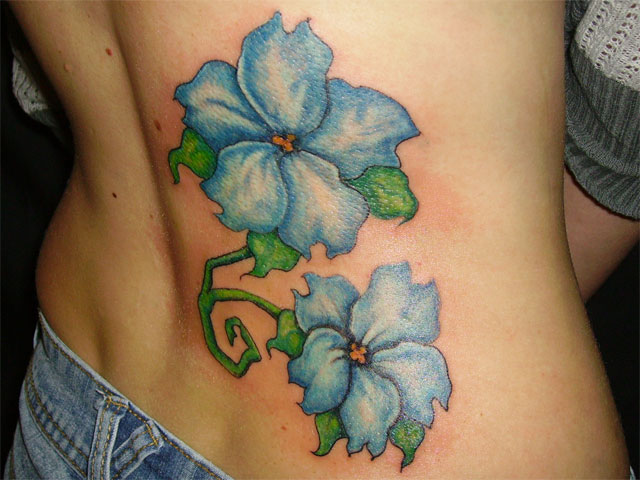
"Blue Flowers," one of Kristin Foley's custom tattoos.
“Blue Flowers,” one of Kristin Foley’s custom tattoos.

On a note outside her studio door, Kristin admits that having to deal with some serious health issues, including Type 1 (insulin dependent) diabetes, diabetic neuropathy and fibromyalgia can sometimes dampen her creativity.  Despite this, Kristin went back to school to obtain her BFA in ceramics/printmaking and graphic design.

Had I more time to wander the River Arts District, I might have discovered additional back stories inside each studio, tales of accidental vocations. I myself didn’t start writing fiction until I was past 50, signing up for a New York City writing course on a lark.

On that first train ride to the city, I couldn’t foresee that my voyage would unleash a wellspring of stories, let alone a full-length book. It just goes to show you: don’t be surprised what happens when you pick up a pen or a paintbrush. Or a tattoo needle.
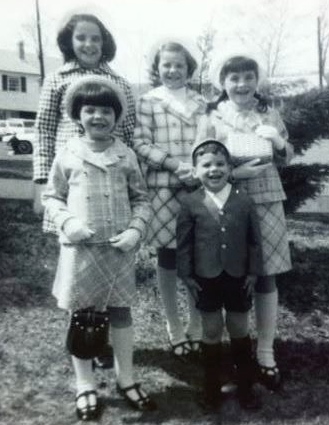
I Could Write a Sonnet…

When we were five: that's me, the tallest, in my patriotic Easter outfit circa 1970.  My youngest sister had not yet arrived.
When we were five: I’m the tallest in the back row, euphoric in my patriotic Easter outfit circa 1970. My youngest sister had not yet arrived.
Or perhaps not, poetry not really being my thing, although I’ve been known to throw down some choice song lyrics when it serves me (or a character). But about two and a half years ago, I believed I could write a book, and put metaphorical pen to paper.

What emerged was close to two thousand pages of blood, sweat and tears, if you total all the sheets in my teetering stack of rubber-banded drafts, output that placed me on a first-name basis with the Staples copy center clerk.

Guided by thoughtful first readers, gifted editors and a diligent hands-on agent, Elisabeth Weed, “Deliver Her” is today a taut 88,000 words and about to reach a wider, more influential audience.

With no work left to do (although any future editors will surely argue this point), I envision my manuscript heading out to the literati the way my sisters and me, and eventually a brother, blossomed on Easter Sundays of our youth: preening and grinning in holiday finery, ignoring the nip of elastic cleaving bonnets to our heads and the pinch of new shoes.

Like all mothers of that era, mine worked slavishly to assemble just the right outfits, dragging us up and down Route 17 in Bergen County, New Jersey, the promised land of shopping. The outsized graphic mural on the wall of Alexander’s department store (now departed) heralded our arrival. When we were just four girls, my mother paired us off and buttoned us into complementary suits in jelly bean shades. My brother’s arrival offered a new sartorial challenge; he debuted in short pants and knee socks, setting the bar for fedoras at four.

With such a large family, Easter was one of the rare occasions when new clothes were purchased for all, although straw bonnets were exhumed from the attic, punched back into shape and rebanded with fresh grosgrain.

This coordination could only last so long. The oldest, I moved into junior sizes. Under my mother’s tutelage, I chose a red, white and blue houndstooth suit with large brass buttons. My shoes were navy that year, with ribboned roses at the toe, the entire ensemble emitting a distinct stewardess vibe.

With the birth of my youngest sister, less effort was expended at Easter. In subsequent years’ photos, communion and confirmation dresses reappear, recycled for Easter. With the exception of a random headband, heads are bare. Teenagers’ downcast eyes replace the unbounded joy of younger holidays.

But now, paraded across my sister’s Facebook, these Easter portraits evoke Polaroid memories: foam rollers dropped on dressers before church, annual boardwalk parades, licorice patent bags, crisp white gloves. I toiled to create similar stories for my own two daughters until they, too, aged out of the experience. They have their own photos now.

So while I wait for feedback on my novel, I cross my fingers this discriminating audience will embrace all its wrinkles and view my manuscript as I do: all dressed up with someplace to go.

How Big Is Your Brave?

prison notes
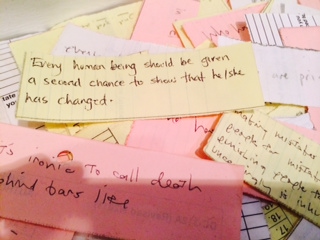
Actual notes from prisoners piled at entrance to Haverford College Prison Obscura exhibition.

I’ve been thinking a lot about prison lately. Blame it on “Orange is the New Black” binge-watching. Or my recent visit to a Haverford College exposition entitled Prison Obscura, curated by Pete Brook and admirably installed by Matthew Seamus Callinan at the college’s Cantor Fitzgerald Gallery. (Full disclosure: Mr. Callinan is a nephew, godson and friend.)

Via rarely seen surveillance and evidentiary photographs, Prison Obscura exposed the horrendous conditions under which many prisoners are forced to live, including overcrowding, and the inhumane practice of housing inmates in metal cages when cells are in short supply.

Prison Obscura was also a haunting documentary of the prison experience, via Robert Gumpert’s recorded audio stories from prisoners within the San Francisco jail system, as well as a look at their hopes and dreams, shared during various prison workshops.

Perhaps most upsetting of all, both OINB and the Haverford exhibit put forth the discomfiting premise that for many who leave prison without a plan or safety net, incarceration may actually be preferable to life “outside.”

This was the immediate conclusion I drew this morning after reading a local news story about a man whose first act upon release from prison after serving 15 years for the robbery of a New Jersey shoe store was to return to that same shoe store and rob it again, in exactly the same fashion as the first time, only to be apprehended and jailed in short measure.

It might have been revenge, or maybe this individual just needed the fastest way back to three squares and a pillow to lay his head on. Who knows. It’s just scary that in his mind, at least, that was the best option society could offer.

On the other hand, there are enterprising souls like Thomas Mickens, who served 20 years of a 35-year sentence in a federal prison before being paroled and launching The Tommy Experience, a fitness company focused on older adults. The ex-con cum fitness entrepreneur, whose crimes included conspiracy to distribute cocaine, money laundering and tax evasion and who was fined $1 million, said his post-prison business plan is a tribute to his mother, who died while he was in solitary confinement. She was in a nursing home and paralyzed by a stroke, he explained in a recent New York Times article.

Mr. Mickens is relying on the same business savvy that earned him the dubious reputation as one of “the top five drug kingpins in southeastern Queens in the mid-to-late ’80s, with more than 50 people on the streets selling drugs for him,” according to the article. Unfortunately, most inmates lack Mickens’s acumen and creativity, having been sentenced to a street life simply by virtue of being born into poverty.

The closest I’ve ever gotten to a prison is chaperoning a student trip to a kind of “Scared Straight” presentation. But I’ve glimpsed other prisons, like the bars that slam down when we confine ourselves by poor choices. Or the jails our bodies can become when felled by injury or disease.

My mother recently celebrated her eightieth birthday in a rehabilitation center in Florida, where she is recovering from a brain injury that resulted from a fall. She is slowly regaining physical strength but struggles occasionally with putting words in the right order. My heart aches listening to her: she pinpoints the word in her brain, only to lose it somewhere in the translation, resulting in gibberish, like a typist’s hands mislaid on a keyboard. Her frustrated eyes plead with me to understand. I tell her to be patient; it will take a while.

And then the following day, the miracle that is the brain: my mother’s speech is letter-perfect.

Overall, however, her progress is slow, with good days and bad. In the mornings before I visit, I run a few miles along Jupiter’s beach, listening to the five new songs I loaded on my iPod. (This is when I get to hear the song’s actual lyrics instead of the ones I imagined hearing on the radio.) On one morning run in particular, words resonate from Sara Bareilles’ “Brave:”

Maybe there’s a way out of the cage where you live
Maybe one of these days you can let the light in
Show me how big your brave is.

Mr. Mickens’s “brave” is pretty big, but not as big as my mother’s.

Tell Me Something About Yourself

Photo credit: Letters at Tiffany’s, Jen Gallardo

Is there anything more wrenching than finessing the first line of a query letter? Laying my author’s soul on the line in this manner takes me back to my early days of job hunting, when a serendipitous connection helped me wedge my foot in the door.

My first job out of college was as a reporter for a small weekly newspaper. Fresh out of journalism school, I accepted this offer over a slot in a department store management training program and a cubicle at an insurance company proofreading policies. (Such was the diversity of my state college’s job lottery.) As a child of Watergate, I was positive this job would plant me on the path of becoming the first female Woodward or Bernstein.

It was a great job, but a grueling one, as getting-your-feet-wet positions tend to be. My editor, a Ray Romano type (not cuddly “Everybody Loves Raymond” Ray but curmudgeonly “Men of a Certain Age” and “Parenthood” Ray), was extremely demanding. In his small shop, the second story of a converted house where the walls slanted crazily, we reporters did everything, from taking photos to writing captions and headlines to inserting typesetting codes in our copy in those typewriter days.

I didn’t realize it at the time, but it was excellent training for everything that was to come.

We worked four long days, publishing on the fifth. My salary was so low I took a job working our presses on Wednesdays to cover my car payment, shoving the collating machines full of the sections I had finished writing hours before. (This is my personal “I walked 10 miles to school” story that I trot out whenever my children complain about life’s difficulties.) My blue collar colleagues would glare at me when my editor pulled me off the line to tweak a late-breaking story; I came home covered in newsprint.

After a year, I was ready for something else, and began browsing the classifieds. An ad for a communications coordinator intrigued me. Reading further, I did a double-take at the name of the person receiving resumes. The moniker was too distinctive to be a coincidence; I recognized it from the yellowed clippings in my file drawer. This individual, my prospective employer, had been a reporter at this paper only a few years before.

This happy accident provided a great (or risky) opening line for my cover letter: Dear so-and-so, I’m sitting at your former desk at the Pleasantville News (newspaper name changed to protect the curmudgeon).

It got me an interview. Eventually, I got the job. This fellow journalism refugee turned out to be a great boss and writer, a former high school English teacher who taught me about the precision of language, drilling into me the difference between “that” and “which,” a rule I have religiously enforced among writers I’ve edited over the years, to their collective annoyance. Said boss later admitted that while my talent dazzled him (this is not a direct quote), curiosity about the newsroom he’d left behind had been a contributing factor to my first interview.

I’m relating all of this because I’m on the same sort of hunt today to get an agent’s attention— to wow them with the first sentence and make that crucial connection right out of the gate. The Internet affords writers all sorts of background on agents and authors—a kind of virtual file drawer cataloging their likes, pet peeves, favorite authors, query turnoffs, etc.

At the same time, with equal access to this database, it’s a challenge to stand out in a writerly crowd.

It’s slow going. I’m approaching each query as a challenge. Each one gets a little tighter, I think, and a little shorter, which I hear is a good thing. It’s only been a week, barely a nanosecond in query time, but I’ve got a pretty big foot to shove in that digital door.

Twizzles, Harry Connick Junior, and Me

Breathtaking performances, agonizing waits for judges’ critiques, tears, exhilaration, relief.

These heights and depths are currently playing out in two dramatic locations—Sochi’s Olympic venues and American Idol’s Hollywood studios—as well as in one obscure corner of the world: my writing office.

My workspace is my practice hall, where in the early morning hours, I put myself through my paces, polishing book drafts, essays, short stories in the hopes of scoring that perfect 10 —representation, publication, or a book deal— or at the very least, a second look, which in Idol parlance, translates to Harry Connick Jr. handing you a ticket to Hollywood Week.

No guarantees, but you’re still in the running.

Yes, we writers experience highs, like the ping of publication or the rush of a pitch getting an agent’s attention. These are worth a million early mornings. Then there are the lows, when the rejections pile up— or worse, when there is no acknowledgement of the dozens of queries you’ve launched into the murky darkness of digital submissions.

I could go on ad nauseum comparing writers and artists to Olympic hopefuls and Idol contestants. But I won’t. I’d really rather just get back to my writing, but in today’s literary landscape, that isn’t enough. We also are expected to ably post, tweet and otherwise self-promote from social media platforms more sophisticated than Sochi’s slopestyle course or the pairs’ long program. I suppose this is the athlete’s equivalent of a slopeside Access Hollywood interview or a chat with Ellen post-Idol elimination— it comes with the territory.

The truth is, publishing, like sports, music, and any other industry where only a few can rise to the top, has upped its game. Did anyone know what a Twizzle was ten years ago? When Simon Cowell first hit our shores in his blinding white tee shirts, were the Idol contestants accompanying themselves on guitar or keyboard? Can you imagine Hemingway’s Instagram feed?

The stakes are higher today: those who want to make an impression—a lasting impression—must up our games as well.

So yeah, maybe I’m not so different from my dawn patrol comrades: the skaters showing up at the rink for a 5 a.m. practice, or the Idol hopefuls in line to audition before sunrise. You just have to keep putting yourself out there. Because you never know when that big break will come.

I do feel the pressure a little more than most. After all, I’m the same age as the oldest Olympian in Sochi, Hubertus von Hohenlohe, a six-time Mexican Olympian who is also a German prince.

He came to Sochi knowing his chances of medaling were slim. But Hubertus has a plan: If the Olympics don’t pan out, he can fall back on his recording career. Among other pursuits, Prince Hubertus is also a pop star who goes by the name of Andy Himalaya.

When Andy Himalaya quits his day job, then I will, too.

Empty Notebook, Empty Nest

Photo by Albert Herring

What am I working on next? To echo author Charlotte Mendolson, please don’t even ask that question.

If a writer longlisted for the 2013 Man Booker Prize can feel that way, I can, too.

It is at once an exhilarating, paralyzing place to be — facing that veritable clean slate, blank screen, empty notebook — MacBook, in my case. Having wrapped up my first novel, Deliver Her (the writing part that is; not the selling part), I’m free to begin a new chapter, so to speak.

The anticipation is not unlike waiting for slovenly teenagers to grow up and move out — only to be moved to tears by the sight of their empty rooms, caught off guard by a calendar of unscheduled hours.

This is no random metaphor: at the same moment I’m casting about for a new project, my house has abruptly, prematurely emptied, my spouse and I eyeing each other the same way I regard the empty page — with a mix of giddy excitement and terror.

Be careful what you wish for.

Now that I finally have the luxury of time, it feels like a sanction. Though the discipline remains, the rigors of a self-imposed deadline have vanished, along with the concrete task that awaited me each morning. Like school lunches to be packed, or homework signed.

Only in the case of writing, it was a little something I’d left for myself at the end of the previous day’s efforts, a gift to begin with.

Now I need a new story to replace the old one, a new rhythm, a notion that so fully engages me it shakes me awake with ideas, interrupts my runs, taps me on the shoulder while I’m at my day job.

It’s not that I don’t have a million ideas. I do — files full of inspiration, character names, titles. I’m good at titles. I think this comes from years of writing headlines. I have dozens of pieces I could revise for submissions, a hundred-plus pages of memoir-worthy prose, though those recollections are still too raw for publication. I’ll let them age a few more years.

I thought I knew which story I would tell next — the “humming secret in my head,” as Alison McLeod so eloquently describes her next literary endeavor, the early treatment of her next novel.

But doubts linger. What if I start something new, but the story sputters? Or there’s no heart to propel me forward? I might be tempted to “rest and recover,” as NoViolet Bulawayo did following the success of “We Need New Names:” “I’ve been trying to do a story collection,” she explains, “But it felt like I was pinching a stone so I’m leaving it alone.”

Now there’s a metaphor.

Even as I polish this post over several days, germs of ideas take root. This makes me happy. This is apparently how it is supposed to go. Memoirist and novelist Dani Shapiro says this about starting over: “I’m a much nicer person when I’m working on a book. When I begin I have so little to go on — a feeling, a sense, an image or two. It’s like coaxing shadows out of the corners.”

I, too must have faith the idea will come, and that it will grip me, the way an infant’s tiny fingers latch onto the neck of your sweater. Just as I know that teenagers have a way of growing up and coming back, a little more polished than when they left, like a strong second draft of a novel.

‘Mouths in Tight O’s’ and Other Book Club Critiques

It was a hysterical sight: seven women around my dining room table contorting their mouths into approximations of a tight O — a literary descriptor I am apparently quite fond of.

“You use it a lot. I had to stop reading and try to picture it,” said one as she pursed and stretched her lips. The rest quickly followed suit.

I nearly fell off my chair laughing at the group grimaces, but that’s the kind of feedback you’ll get when you ask a book club — your own book club — to review your first novel.

In a burst of bravado, I had assembled my fellow readers, all close friends, to review a polished draft of “Deliver Her” — my tale of a distraught mother who hires a professional transporter to drive her teenage daughter to treatment in New England, a voyage that goes dangerously awry.

Our book club disbanded several years ago, but when I timidly ventured last year that I was working on “a little something,” the club pledged to reconvene if and when my “little something” materialized. Which is why, after sating ourselves with chili, dried meat snacks (okay, so foodie book clubs might find themselves a little challenged by my debut effort) and plenty of wine, we were at my table and getting down to the business of book-clubbing.

Was I scared?  Only a little. It was right up there with wearing a bathing suit in front of co-workers — worse than being naked.

But since I already had gathered feedback from about two dozen first readers, my authorly skin had thickened slightly.

Good thing: roaring out of retirement, my book club took this assignment quite seriously. I think it was one of the rare times every last member finished a book before our meeting. It was as though we’d never disbanded — these women with whom I had soldiered through nearly three dozen books over three years.

We kicked off in 2008 with “Glass Castles” by Jeanette Walls and wrapped up with Diana Gabaldon’s “Outlander” — this last reviewed in a local bar. It was with no disrespect to Ms. Gabaldon that we closed the book on our club that night after a long, satisfying run — including a holiday gathering with spouses that centered around Anita Shreve’s “A Wedding in December,” Ginny’s white coconut cake a masterpiece. Some of the men even took a shot at the book.

After all, we weren’t that kind of book club, a strict one with all the rules. We were as much about the laughter as the literature.

Disbanding didn’t stop us from being friends. It just meant that books aren’t the main reason we get together anymore.

Except for tonight. This night, in my home, with my book, the club was reenergized, well-prepared.
These readers had a lot to say about “Deliver Her.” Their suggestions were heartfelt, astute and most of all, supportive, and deeply influenced the second iteration I sent off to an encouraging literary agent just before Christmas.

We so thoroughly enjoyed ourselves we even talked of resurrecting the club. After all, our children were older and less demanding, we reasoned; there are even empty nesters among us. Time will tell. Maybe a film club this time around: no prep required.

In the meantime, I am extraordinarily grateful to these women and to all my first readers for their time, feedback and encouragement. I will acknowledge them properly when “Deliver Her” sees the publishing light of day — in print or in Paperwhite.

For now, I plan to swallow hard, bare all and invite them to follow me here and elsewhere while I work to deliver “Deliver Her” to the masses.

And just for the record: when I checked my draft, tight O appeared only once in 320 pages, though overall, I lean on this letter far too heavily. After all, Word’s search results don’t lie:  

  • Pursed in a tight ‘O’
  • A perfect ‘O’ of white hair
  • The gaping ‘O’ overhead
  • The white ‘O’ around his mouth
  • Mouth open in an ‘O’ of surprise

O no. I will be energetically employing the other 25 letters in future projects. Stay tuned.

In Writing, As in Life: Nothing Ventured, Nothing Gained

My 320-page manuscript weighs a satisfying five pounds, about the same amount I’ve gained while creating it over the last year. It’s a small price to pay for completing this creative marathon. As every writer knows, when you commit to this — really commit to the process — something has to give: time, sleep, social life, sex. In my case, it was my waistband.

To be more specific, it was my morning run that took the hit. It’s not that I gave it up completely. It’s just that by necessity it became rather abbreviated. In the beginning, I would wake at 5 a.m. with the best of intentions, determined to do it all: write for three hours, run for one. But as the coffee kicked in and I got down to it, it became excruciatingly difficult to stop at the appointed hour. So my five-miler dwindled to a four- or maybe a three-miler, the whole morning ending in a mad damp-haired dash to the office, where I actually get paid to write.

(Run at night, you say? Can’t. I’m one of those people who has to write and run in the morning. That’s when the “legs” are the freshest, for both processes. Evenings are for revising and yoga.)

Still, I had the sense not to give up the running completely, because what I’ve come to realize is that these brief workouts are exactly that: a chance to “work out” the kinks in my writing. They are as essential to my process as reading, writing, revising. They ignite the brain cells. A few minutes into my boardwalk run, the pistons start firing, and the mental edit begins. The sentences and dialog that stumbled from my brain to the virtual page in the pre-dawn hours coalesce. While I listen to the same 27-song playlist, I listen to the characters in my head. By the one-mile mark, some of the thorny narrative impasses I left on the virtual page no longer seem insurmountable. I have options, possibilities.

The result is that by the time I’ve finished my run, my brain is buzzing with so many notes and ideas that I’m terrified that I will lose them. I jot them in the small notebook in my car’s cup holder before they float away. I’m sure there’s some high-tech way to dictate notes to myself while I run, but that’s too geeky — like wearing the race tee shirt while you’re running the race.

At home, I transfer my notes to Post-its. I plaster my desk with them, the seeds for tomorrow’s work.

Quiet! Healing in Progress

My neighbor’s warning rang in my ears as the hospital ICU doors swung open. “Don’t look at her right after,” he had cautioned. “She’s going to look like she’s dead.”

My mother’s latest open heart surgery had ended an hour ago. For the second time in 11 years, surgeons had sawed her sternum in half and spread it apart to repair the damaged organ. During the five-hour valve replacement, her heart was stilled for a time, blood pumped through her body by a cardiopulmonary bypass (heart-lung) machine — a high-tech autopilot for vital organs that first kept a cat alive for 26 minutes more than 75 years ago.

Today, the brainchild of Philadelphia surgeon John Heysham Gibbon stands in for hearts and lungs in operating theaters around the world. The pump is controlled by a perfusionist, an artist who tunes its rhythms in the symphony that is cardiac surgery — not unlike the deep, rich tones a double bass lends to a jazz orchestra.

Only two family members were permitted at my mother’s bedside post-surgery. On the ICU wall, a sign asked for quiet: ‘Healing in Progress.’ As we waited outside her curtained cubicle for permission to enter, I considered ceding my spot to my sister. I did not know if I could bear the sight of my mother hitched to every kind of tube and monitor, the death’s door scenario my neighbor had prepped me for.

But when the curtain swung open, I stepped inside with my father, eyes resolutely avoiding the thick plastic hose protruding from her neck, the drops of blood on the floor below the bed. My mother’s face was pale and slightly swollen, but the beeps emanating from overhead monitors signaled she was very much alive.

In fact, she’d done very well for a ‘reopen,’ the staff said, referring to her earlier operation. A few days later, minus most of her hospital hardware, my mother was stepped down to a cardiac bed in the prominent New York hospital. From a pair of chairs one afternoon, we watched the sightseeing boats glide up the East River. Eventually, my mother tired, and her head nodded toward her bruised chest, which had been Steri-Stripped shut.

I thought again of that heart-lung pump, of the myriad patients who enter its technology-induced twilight, the sort of corporal suspension, every day. One can only wonder where the body and spirit reside during its stop-motion limbo.

First Brush

Gig's moon and stars.
Aunt Gig’s moon and stars.

For an author, reading the first draft of one’s novel is a little like an actor watching themselves on screen.

I’d like to claim that analogy, but I must give credit to my hairdresser (or level III stylist or whatever the politically correct title). Mariana is a very astute woman who, like many of her profession, dispenses a great deal of useful advice that often has little to do with my hair.

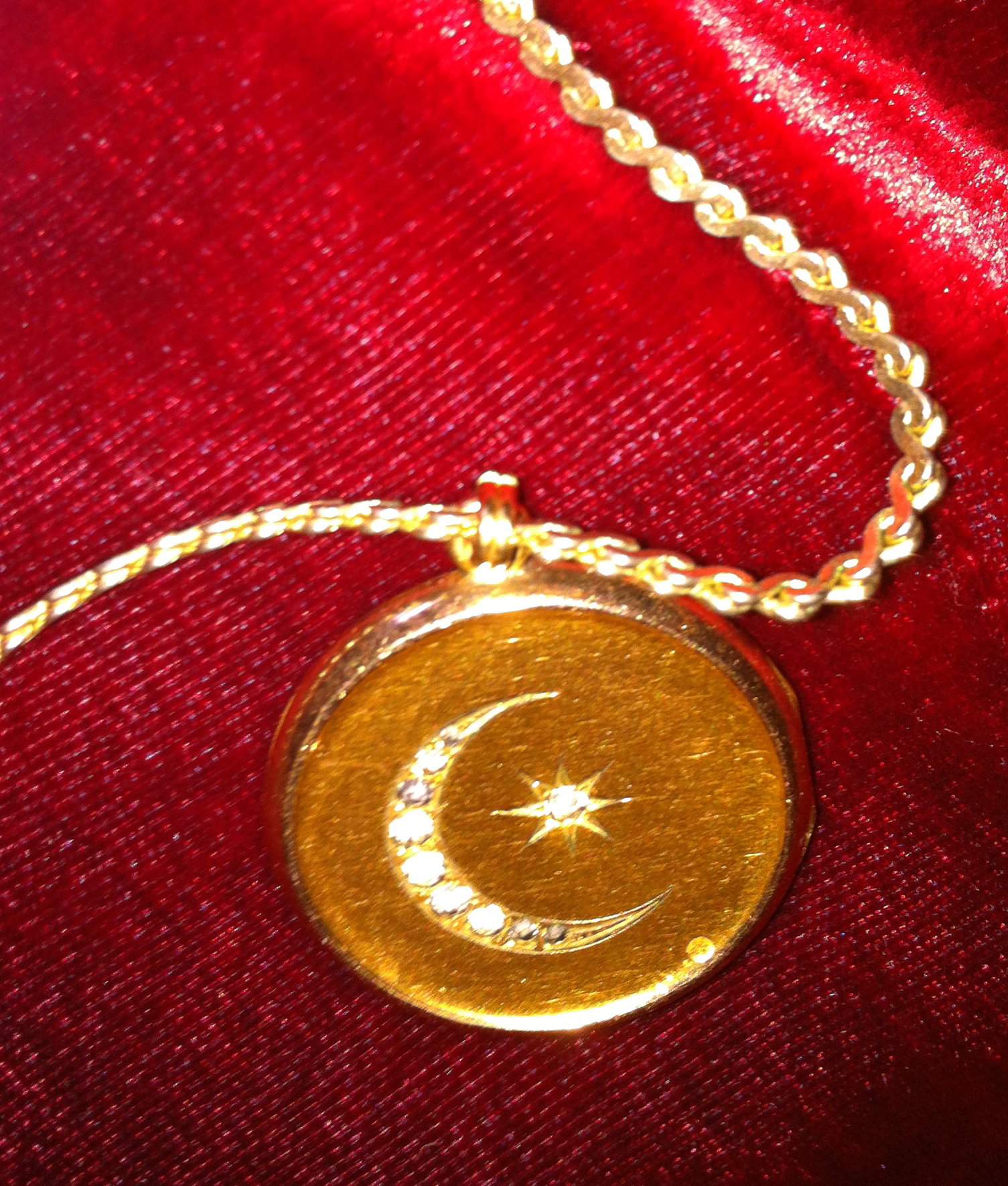
Take my last appointment. She stopped by the sink where I was being shampooed to greet me and compliment me on a pendant I was wearing — a gold locket encrusted with a half moon and stars of tiny diamonds. It belonged to my great-aunt Gig (my grandmother had 18 siblings in all) and languished in my mother’s jewelry box for years. I’d been drawn to it lately and had taken to wearing it.

“That’s so pretty,” she said, leaning in to examine it.

“Thanks,” I said, twisting painfully in the sink’s awkward hold. “I think it’s missing a couple of stones, though.”

She squinted. “No, it’s not. I can see them all. It just needs a cleaning. Dip a little brush in some window cleaner and scrub it gently. That’s all it needs.”

Or the appointment before that, when we puzzled over unusually dark results from an at-home root touch-up. After a grilling that would make a detective proud, Mariana had two theories: either problematic iron levels in our neighborhood water created an iron buildup, or a sweaty workout left a hefty salt deposit. The presence of either mineral could cause color to ‘take’ more deeply than usual.

That’s the kind of information I count on Mariana for. She tells me she keeps an arsenal of stain removal products in her laundry room — armed to attack any spill or mishap on hers or her husband’s clothes. She ticks off a few solutions when I complain about discolored towels. (Problematic neighborhood water again; everything we own tinged peach for the last year.)

Subconsciously, I may have been thinking of her when I had Iris, a secondary character in my novel, Transported, dip an old dress in chamomile. That’s just the kind of thing Mariana would do.

She credits her knowledge to her late mother, a seamstress. Mariana grew up watching her create and repair clothes for other people. During a blowout, she offers a tip on reviving faded black clothes: dye them. I think of a favorite shirt in my closet that could benefit from this facelift. I would have tossed it otherwise.

On the day Mariana made her astute analogy, I was grousing about the read-through of my first draft. Though I poured my heart and soul into this 350-page bundle, the going was extremely painful, especially at the beginning, where I really flailed. As in any first draft — book, film, garment — there’s some brilliant stuff, some terribly cringeworthy stuff, and just a lot of stuff that should be cut. I longed to hand off the whole mess to someone else to fix.

And that’s when I thought of Mariana’s shelf. Writers need their own go-to tools to attack the stains and messes in their work: editing, rewriting, and the most challenging of all, leaving a WIP alone for a good long while, then picking it up again with fresh eyes.

It’s only then that I, the author, can decide which elements really sparkle, which need a gentle brushing, and which, like old clothes that have had their day, are best tossed.